AI Amplifies the Mid-Career, Not the Junior — A Counterintuitive Truth
The feed says: "AI is here, mid-career goes first. Juniors learn faster and still have the stamina — cash out before 35." Sounds plausible. The direction is reversed.
Pull the last three years of public data apart: AI favors juniors on narrow, closed tasks; AI overwhelmingly favors mid-career engineers on broad, open ones. A mid-career engineer's judgment, failure-smell, system thinking, and organizational fluency aren't replaced in the AI era — they're multiplied.
Two axes first — the whole post is built on these two:
- Narrow ↔ broad: scope. Narrow = one function, one bug, one ticket — the change doesn't leave its cell. Broad = cross-module, cross-team, change-one-thing-and-upstream-downstream-all-have-to-shift kind of system move.
- Closed ↔ open: clarity. Closed = the spec, requirements, SLA, and acceptance criteria are nailed down — go execute. Open = whether to build it, how far to go, who to align with, how to roll back when it breaks — no standard answers.
The four combinations: Narrow + Closed = fix a known bug to spec; Broad + Closed = system design with known requirements; Narrow + Open = prototype in a new stack; Broad + Open = whether to ship the project at all and how to recover when it breaks. The quadrant figure later in the post lays out concrete examples in each cell.
This post unpacks the counterintuitive truth.
The Default Narrative: Why It Sounds Plausible
The "AI kills mid-career first" story spreads because it sits on top of real things:
- The coding step really has been heavily AI-substituted. What used to take a junior 3 years now ships in 1.
- Mid-career comp is 2-3× junior comp, so ROI math at headcount-cut time targets exactly this band.
- In layoff stats at large tech orgs, the 35-45 share is genuinely rising.
So the narrative looks self-consistent. But it equates "AI substitutes for code production" with "AI substitutes for engineers" — and that step is wrong.
Code production was never more than a small fraction of an engineer's value. What actually drives compensation is the rest — and the rest is exactly what AI cannot do in the short run.
Real Data: The Direction Is Reversed
Stitch together the last three years of public studies:
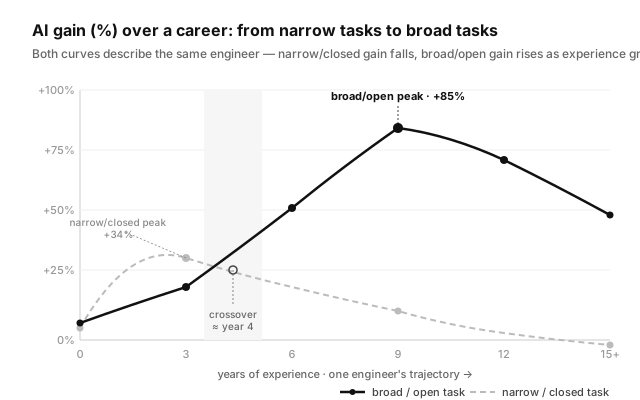
Read the chart correctly first: both curves describe the same engineer, not two different people. A mid-career engineer is just a junior who stayed and added five years. AI's gain doesn't favor an age cohort — it favors a task structure. As experience accumulates, narrow/closed gain shrinks (tacit knowledge is already codified into suggestions; you know that part), while broad/open gain grows (you can finally direct AI). The real mechanism by which AI makes experienced engineers more valuable: it rotates every engineer's AI-gain mix from narrow-dominant to broad-dominant — and broad is where most of the comp lives.
Read the data below in two parts:
On closed, narrow tasks, less-experienced engineers gain more:
- Brynjolfsson, Li, Raymond 2023 (NBER): in customer support, AI lifted productivity 14% on average — but +34% for new/low-skill workers and ≈ 0% for top performers. AI compressed the veterans' tacit knowledge into a script and handed it to juniors.
- Microsoft Copilot RCT (Peng et al. 2023): an HTTP server coding task — 55.8% faster overall, larger relative gains for less-experienced programmers.
- GitHub Copilot field experiment (Cui et al. 2024): ~26% increase in PR completion, juniors gaining more.
But on open, ambiguous tasks, the direction reverses:
- METR 2025 study: experienced open-source maintainers using AI on their own well-known codebases were 19% slower — while perceiving themselves as 20% faster. But the same people in unfamiliar domains saw real speedups.
- A year of Devin at Goldman Sachs: the CIO's stated number is ~20% hybrid-workforce gain. Every public interview emphasizes that senior engineers extracted the value; juniors clogged the review queue.
- Public usage data from top AI coding tools: top-decile users out-produce the median by 5-10×, and almost all of them are staff-plus engineers.
Put the two clusters side by side and the real dividing line shows up — it's not age, it's task closedness.
The Task Quadrant: Who Captures AI's Gains
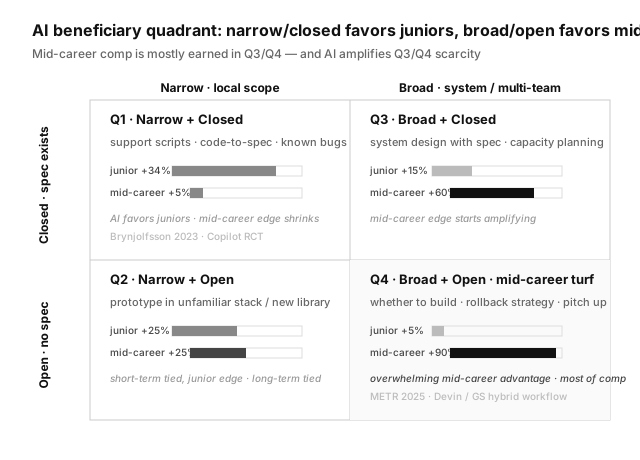
Quadrant 1: Narrow + Closed (support scripts, code-to-spec, fix a known bug) Juniors win big. AI codifies senior tacit knowledge into suggestions juniors copy. In this quadrant, mid-career relative advantage is genuinely shrinking.
Quadrant 2: Narrow + Open (write a function in an unfamiliar stack, prototype with a library you haven't used) Juniors edge ahead slightly. But mid-career engineers judge sooner whether the prototype is worth continuing. Roughly even short-term; even long-term.
Quadrant 3: Broad + Closed (system design with known requirements, capacity planning under given SLAs) Mid-career advantage starts amplifying. AI offers 10 options; choosing the right one — and explaining why not the other 9 — needs the mid-career engineer's "last time we did it this way it blew up" memory.
Quadrant 4: Broad + Open (whether to do this at all, where to stop, how to pitch it up, how to roll back when it breaks) Overwhelming mid-career advantage. AI has no idea how your org actually operates, who upstream/downstream will block you, who in compliance or security holds a veto. This is the asset mid-career engineers built up through a decade of project failures — and AI has no training data for it.
Why is mid-career comp 2-3× junior comp? Because the judgment value in Quadrants 3-4 is much larger than the execution value in Quadrants 1-2. AI flattens Quadrants 1-2 — which makes the scarcity in Quadrants 3-4 more visible, not less.
Four Mechanisms by Which Experience × AI Compounds
Why does experience get amplified by AI on open tasks? Four concrete mechanisms:
Mechanism 1: Problem selection (taste)
AI's code-writing speed is 5-10× faster, so the relative weight of "what to write" is 5-10× larger. Mid-career engineers have shipped (or watched fail) 10+ projects from kickoff to launch. They know which requirements are real, which are anxiety-driven, which will ship to no one. Juniors lack this filter. AI lets a single prompt produce a demo — but whether the demo is the right thing to build, juniors can't answer.
Mechanism 2: Failure smell (smell test)
80% of AI-generated code looks right; 20% is plausibly wrong:
- Edge cases silently swallowed
- A deprecated API still in use
- A concurrency-unsafe library treated as thread-safe
- A DB query that works but full-table-scans
A mid-career engineer smells these in seconds because they've stepped on every landmine. A junior reviewing the AI PR sees "looks fine" → merge. Production-incident rates on junior-led AI teams run an order of magnitude higher than on mid-career-led ones.
Mechanism 3: System thinking
AI optimizes locally — this function, this query, this component. It's bad at system-level tradeoffs — what to cache, where to draw boundaries, when to refactor vs. patch.
A mid-career engineer carries a mental map of the system:
- Where the largest bottleneck actually sits in the chain
- Which adjacent teams a change will ripple into
- Whether this abstraction will look like an asset or a liability in 6 months
AI has none of this — only a snapshot of the codebase, no 3 years of decision history, no 6-month roadmap.
Mechanism 4: Organizational fluency (delivery)
Writing the code is 30% of shipping. The other 70%: alignment, review, rollout, monitoring, rollback, communicating to adjacent teams, reporting up, writing the postmortem when things break. This 70% is what turns "code" into "product" — and AI helps almost zero with it. If anything, AI inflates code throughput, which enlarges the review/alignment/release bottleneck.
A mid-career engineer who's been in the org for 10 years knows which reviewer is strict, which team to ping before touching their API, who to escalate to for things to actually move. A junior doesn't grow this in three years.
The Real Mid-Career Risk Isn't AI — It's Not Using AI
The data says AI is widening the gap between mid-career and juniors. But there's a precondition: mid-career engineers actually have to use AI.
The single biggest AI risk for mid-career engineers isn't replacement — it's path dependency:
- "I'd rather write it myself."
- "AI code looks ugly; fixing it is slower than writing it."
- "I don't trust it; I review every line."
In this mindset, AI shows up as "a junior who types slowly," the experience is bad, and the engineer abandons it. Meanwhile, the grindy mid-career engineer across the street is multiplying their output by 3.
Public and internal data converge on one distribution: the productivity gap between AI-using and non-AI-using mid-career engineers is now larger than the gap between mid-career and junior engineers.
Four Concrete Moves for Mid-Career Engineers
Move 1: Treat AI as leverage, not a competitor
Leverage amplifies your strength. Your strength is judgment; AI's strength is execution — let AI execute your judgment, not replace it.
Concretely:
- Let AI write the implementation; you define the spec, boundaries, and tests
- Let AI propose 3 options; you pick one and articulate why
- Let AI write the PR; you review against AI's most common failure modes (boundaries, concurrency, deprecation, performance)
Move 2: Make your judgment explicit
Mid-career engineers carry massive tacit judgment. Writing it down is what makes it AI-actionable — and reusable across the team:
- A project constitution (README + AGENTS.md): the system's core constraints, what cannot change, what must be preserved
- A decision log: why A over B, when to re-evaluate
- A failure-case library: past landmines and where AI tends to step on them
Write it once; AI uses it for a year; juniors onboard with it.
Move 3: Move your front line forward, off "writing code"
AI overflows code throughput; the bottleneck has moved forward (what to build, why) and backward (review, rollout, rollback).
Mid-career engineers should pull effort out of "I write it myself" and push into:
- Requirements decomposition and prioritization (let AI generate the menu; you pick)
- Architecture decisions and component boundaries
- Review standards and test gates
- Postmortems and decision iteration
Move 4: Productize your experience; commercialize the product
If you've accumulated a decade of domain expertise (e-commerce, ads, finance, SRE, DBA, quant), AI is the first time that expertise has a real monetization path:
- Turn it into AGENTS.md / playbooks / Claude Skills / Cursor rules
- Train an internal expert agent on it
- Package it as consulting, courses, or SaaS
These are assets that previously sank because "nobody reads docs." AI turns them into executable, distributable, priceable products.
The real mid-career opportunity isn't competing with juniors on typing speed — it's converting ten years of experience into an agent that works 24/7.
Closing
"AI kills mid-career engineers" is a story made for short videos, not for decisions.
Pull the data apart:
- Narrow, closed tasks — AI favors juniors; mid-career relative advantage is shrinking here
- Broad, open tasks — AI overwhelmingly favors mid-career; this is where most of mid-career comp comes from
- The real risk isn't AI; it's mid-career engineers who refuse to use AI
Same pattern as every previous "industry shift": the surface-level panic is real, but the people who actually lose work have never been the experienced ones — they've been the ones who refused to pick up the new tool.
A mid-career engineer's differentiated assets — judgment, smell test, system thinking, organizational fluency — aren't replaced by AI. Every one of them just got multiplied by a coefficient.
Over the next 3 years, the gap between AI-using and non-AI-using mid-career engineers will be larger than the gap between mid-career and junior engineers. That is the real watershed.